
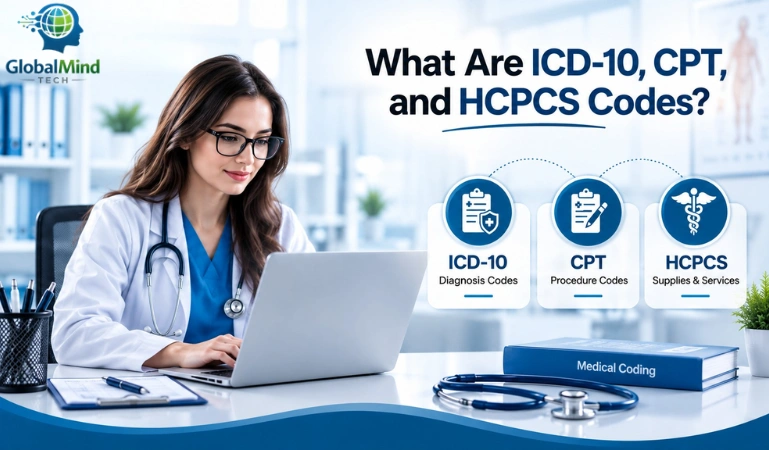
Medical coding is an important part of the healthcare billing process. Every patient visit, diagnosis, procedure, treatment, medical supply, and service must be translated into standardized codes before information can be submitted to an insurance company. These codes help healthcare organizations communicate clinical and billing information accurately.
If you have searched for what are CPT codes, you may also have come across ICD-10 and HCPCS. Although these code sets are often discussed together, they do not serve exactly the same purpose. Each one represents a different type of healthcare information.
Understanding these systems can make medical billing easier to understand and can help providers, practice managers, billers, and patients recognize how healthcare services are documented and reported.
What Are Medical Billing Codes?
Medical billing codes are standardized codes used to describe diagnoses, procedures, services, supplies, and other healthcare-related information. They allow healthcare providers and insurers to communicate using consistent terminology.
A medical claim may contain several types of codes because a single healthcare encounter can involve both a patient’s condition and the services provided to address it.
For example, a patient may visit a physician because of a specific medical condition. An ICD-10-CM code can identify the diagnosis, while a CPT code can identify a professional service or procedure performed during the visit. If certain supplies or services are not represented by CPT, an applicable HCPCS Level II code may be used.
The Centers for Medicare & Medicaid Services (CMS) explains that standard healthcare code sets are used for diagnoses, procedures, equipment, supplies, and other healthcare information involved in transactions.
Accurate coding matters because coding errors can contribute to claim delays, denials, incorrect reimbursement, and additional administrative work.
For a broader introduction to the subject, you can also read Global Mind Tech’s guide to what medical coding is and why it is important.
What Are CPT Codes?
So, what are CPT codes?
CPT stands for Current Procedural Terminology. CPT codes are standardized five-digit codes used primarily to identify medical services and procedures provided by physicians and other qualified healthcare professionals.
CPT is part of HCPCS Level I. CMS explains that CPT is maintained by the American Medical Association (AMA), which updates and republishes the CPT code set annually.
CPT codes can describe many types of professional healthcare services, including evaluation and management services, procedures, diagnostic services, and other professional services.
For example, when a healthcare professional provides a billable service, the appropriate CPT code communicates what service was performed. The code itself does not simply mean that an insurer will automatically pay the claim. Coverage, medical necessity, payer policies, documentation, and other requirements can also affect reimbursement.
Why Are CPT Codes Important?
CPT codes create a standardized way to describe healthcare services. Without standardized procedure codes, providers and insurance companies would have greater difficulty processing claims consistently.
In medical billing, CPT codes are commonly reviewed alongside diagnosis codes. The diagnosis helps explain the patient’s medical condition or reason for the encounter, while the CPT code identifies the service or procedure provided.
This relationship is one reason accurate documentation is so important. The medical record should support the services reported on the claim.
Who Maintains CPT Codes?
The AMA maintains the CPT code set and makes annual updates. Because healthcare services change over time, coding professionals need to use the appropriate current code set and follow applicable coding guidance.
This is also why providers should avoid relying on outdated code lists when preparing claims.
What Are ICD-10 Codes?
Another common question is what are ICD-10 codes?
ICD-10 stands for the International Classification of Diseases, 10th Revision. In the United States, ICD-10 includes different code systems for different purposes.
For most healthcare claims involving diagnoses, ICD-10-CM is particularly important. ICD-10-CM stands for International Classification of Diseases, 10th Revision, Clinical Modification. It is used to classify diagnoses and reasons for healthcare encounters across healthcare settings.
ICD-10-PCS is different. It is used for inpatient hospital procedures. CMS identifies ICD-10-CM as the diagnosis code set and ICD-10-PCS as the inpatient procedure coding system.
What Do ICD-10 Codes Describe?
ICD-10-CM codes describe a patient’s diagnosis, condition, symptoms, or reason for the encounter when applicable.
For example, a provider may document a patient’s diagnosis in the medical record, and the appropriate ICD-10-CM code represents that diagnosis on the claim.
The level of detail available in ICD-10-CM allows healthcare organizations to report diagnoses with greater specificity. CMS notes that ICD-10 provides more detailed classification of health conditions than the previous ICD-9 system.
The correct diagnosis code should be supported by the provider’s documentation. Coders should not select a diagnosis simply because it might result in reimbursement.
What Are HCPCS Codes?
What are HCPCS codes, and how are they different from CPT?
HCPCS stands for Healthcare Common Procedure Coding System. It is a standardized coding system used to identify healthcare services, procedures, products, supplies, and other items.
HCPCS has two main levels:
- Level I: CPT codes maintained by the AMA.
- Level II: Alphanumeric codes maintained by CMS that identify products, supplies, and services not included in CPT.
CMS explains that HCPCS Level II codes consist of one letter followed by four numbers. They can be used for items and services such as durable medical equipment, certain supplies, ambulance services, and other services not represented by CPT.
This distinction is important because people sometimes use “HCPCS” and “CPT” as if they mean exactly the same thing. CPT is actually part of HCPCS Level I, while HCPCS Level II is a separate code set.
ICD-10 vs CPT vs HCPCS: What Is the Difference?
Understanding ICD-10 vs CPT vs HCPCS becomes easier when you look at what each code set communicates.
| Code Set | Primarily Identifies | Common Use |
|---|---|---|
| ICD-10-CM | Diagnoses and conditions | Describes why the patient received care |
| ICD-10-PCS | Inpatient hospital procedures | Describes certain inpatient procedures |
| CPT | Professional services and procedures | Describes services performed by healthcare professionals |
| HCPCS Level II | Supplies, equipment, drugs, and services not included in CPT | Identifies additional billable items and services |
In simple terms:
ICD-10-CM answers: “What condition or reason for care is being reported?”
CPT answers: “What professional service or procedure was performed?”
HCPCS Level II answers: “What additional product, supply, equipment, drug, or service is being reported?”
CMS confirms that HIPAA-adopted standard code sets distinguish diagnosis coding, hospital inpatient procedure coding, outpatient and physician service coding, and supplies or services not included in CPT.
How Do ICD-10, CPT, and HCPCS Work Together?
A healthcare claim may require more than one code set because different codes communicate different parts of the encounter.
Imagine that a patient visits a healthcare provider for treatment of a documented condition. The patient’s diagnosis can be reported using an ICD-10-CM code. The professional service provided during the encounter may be reported using a CPT code. If a separately reportable supply or service falls outside CPT, an applicable HCPCS Level II code may be necessary.
This creates a more complete picture of the encounter.
The codes should also agree with the medical documentation. If the clinical record does not support a reported diagnosis or procedure, simply choosing a code that appears appropriate can create a compliance and billing problem.
This is why experienced medical coders review documentation, coding guidelines, payer requirements, and applicable code-set updates rather than selecting codes based only on keywords.
For practices that want to understand the financial side of the process as well, Global Mind Tech’s guide to medical billing services and how the process works provides additional background.
Why Accurate Medical Coding Matters
Accurate medical billing codes help create cleaner claims and support proper communication between providers, payers, and other healthcare organizations.
Incorrect coding can cause several problems, including:
- Claim denials or rejections
- Payment delays
- Incorrect reimbursement
- Additional claim reviews
- Compliance concerns
- Increased administrative workload
However, accurate coding does not guarantee that a claim will be paid. Insurance coverage, payer contracts, authorization requirements, medical necessity, documentation, and other factors can affect claim processing.
Coding professionals therefore need to distinguish between selecting a correct code and determining whether a payer will reimburse a particular service.
Healthcare coding also changes over time. CPT, HCPCS Level II, and ICD-10 code sets are updated according to their respective maintenance processes. CMS, for example, publishes current ICD-10 and HCPCS information and annual updates.
Common Medical Coding Mistakes to Avoid
Several coding mistakes can create unnecessary billing problems.
Using Outdated Codes
Healthcare code sets are updated regularly. Using an outdated code can result in an inaccurate claim.
Choosing Codes Without Reviewing Documentation
The medical record should support the diagnosis and services reported. Coding should reflect what was actually documented.
Confusing CPT and HCPCS
CPT is part of HCPCS Level I, while HCPCS Level II contains a separate set of alphanumeric codes maintained by CMS. Understanding this distinction helps prevent terminology and coding confusion.
Reporting Unsupported Specificity
More specific does not always mean more appropriate. The selected code should be supported by the documentation and applicable coding guidelines.
Ignoring Payer Requirements
Even correctly selected codes may require additional information, authorization, modifiers, or documentation depending on the payer and service.
For another useful comparison, see Global Mind Tech’s article on medical billing vs. medical coding.
How Medical Coders Help Improve Claim Accuracy
Professional medical coders play an important role in translating clinical documentation into standardized codes. Their work requires more than finding a code that resembles a diagnosis or procedure.
A qualified coder reviews the documentation, identifies the relevant diagnoses and services, applies current coding guidelines, and selects codes supported by the record. Depending on the healthcare setting, coders may also need to consider modifiers, sequencing rules, payer requirements, and other reporting requirements.
Because coding systems are updated regularly, ongoing education is important. A strong coding process combines current code-set knowledge with careful documentation review and attention to applicable guidelines.
Final Thoughts
Knowing what are CPT codes, what are HCPCS codes, and what are ICD-10 codes makes the medical billing process much easier to understand.
The simplest way to remember the difference is that ICD-10-CM primarily describes the patient’s diagnosis or reason for care, CPT primarily describes professional healthcare services and procedures, and HCPCS Level II identifies additional products, supplies, equipment, drugs, and services that are not represented by CPT.
These systems work together to create standardized healthcare information for claims and other administrative transactions. Accurate coding requires current code sets, appropriate documentation, and knowledge of applicable coding rules.
For healthcare practices, understanding ICD-10 vs CPT vs HCPCS is more than a terminology exercise. Correct code selection can support cleaner claims, reduce avoidable billing issues, and improve the overall efficiency of the revenue cycle.
Frequently Asked Questions
What are CPT codes used for?
CPT codes are primarily used to identify and report medical services and procedures provided by physicians and other qualified healthcare professionals. CPT is part of HCPCS Level I and is maintained by the American Medical Association.
What are ICD-10 codes used for?
ICD-10-CM codes are primarily used to classify diagnoses and reasons for healthcare encounters. ICD-10-PCS is used for inpatient hospital procedures.
What are HCPCS codes used for?
HCPCS includes CPT as Level I and HCPCS Level II. Level II codes are primarily used for products, supplies, equipment, drugs, and services that are not represented by CPT.
Is CPT the same as HCPCS?
No. CPT is part of HCPCS Level I. HCPCS Level II is a separate alphanumeric code set maintained by CMS. Therefore, CPT and HCPCS are related but should not be treated as identical terms.
What is the difference between ICD-10 and CPT?
ICD-10-CM primarily identifies diagnoses and reasons for healthcare encounters, while CPT primarily identifies professional healthcare services and procedures. They often appear together on claims because they communicate different information about the same encounter.
Why are medical billing codes important?
Medical billing codes provide standardized information about diagnoses, services, procedures, supplies, and other healthcare items. Accurate coding helps healthcare organizations submit claims using consistent information and can reduce avoidable billing problems.