
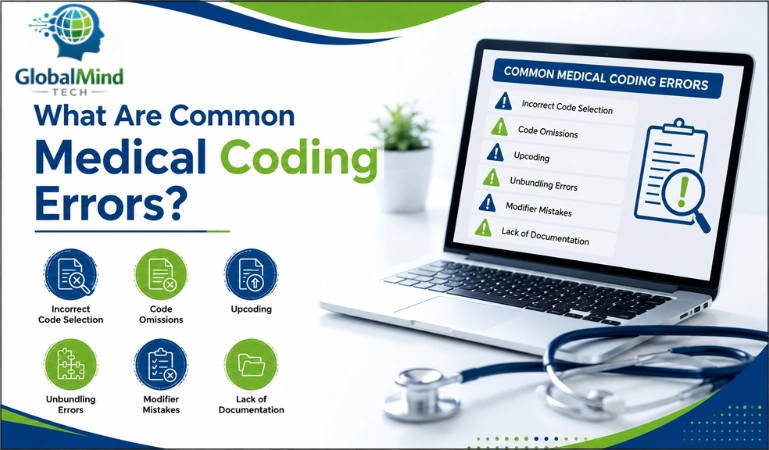
Medical coding plays an important role in the healthcare revenue cycle. It converts diagnoses, procedures, treatments, and medical services into standardized codes used for billing, insurance claims, documentation, and reporting. When codes are incorrect, incomplete, or unsupported by medical records, healthcare providers may face claim denials, payment delays, compliance concerns, or inaccurate reporting.
Understanding common medical coding mistakes can help healthcare organizations improve coding accuracy and reduce avoidable billing problems. From incorrect code selection to missing documentation, even small errors can affect the entire revenue cycle.
This guide explains the most common medical coding errors, the types of medical coding errors healthcare organizations may encounter, and practical ways to prevent them.
Why Is Accurate Medical Coding Important?
Accurate coding ensures that the services provided to a patient are represented correctly on a medical claim. Coders review clinical documentation and assign the appropriate codes based on established coding guidelines.
Accurate medical coding helps:
- Support correct insurance reimbursement
- Reduce claim denials and rework
- Maintain complete patient records
- Support regulatory compliance
- Improve revenue cycle efficiency
- Provide reliable healthcare data
- Reduce unnecessary billing delays
Coding should always be based on the documentation available in the medical record. A coder should not select a code simply because it appears to provide higher reimbursement.
What Are Common Medical Coding Errors?
Medical coding errors can happen at different stages of the coding and billing process. Some result from selecting the wrong code, while others occur because documentation does not adequately support the code reported.
The most frequent problems include incorrect code selection, missing modifiers, inaccurate diagnosis coding, duplicate codes, and insufficient documentation.
Let’s look at some of the most common examples.
1. Using the Wrong Diagnosis Code
One of the most frequent coding problems is selecting a diagnosis code that does not accurately represent the patient’s documented condition.
A diagnosis may be coded incorrectly when the coder misunderstands the provider’s documentation, chooses a similar but incorrect code, or does not review the complete medical record.
For example, two conditions may have similar descriptions but require different ICD-10-CM codes. Selecting the wrong one can result in an inaccurate claim.
Coders should carefully review the provider’s documentation and use the most appropriate code supported by the medical record.
2. Incorrect Procedure Coding
Procedure codes describe services and procedures performed during a patient’s care. Choosing an incorrect CPT or HCPCS code can cause a claim to be rejected or require additional review.
This may happen when a coder:
- Selects a code that does not match the procedure performed
- Uses an outdated code
- Misses a more specific code
- Reports a service that is not supported by documentation
Regular coding updates and careful documentation review can help reduce these errors.
3. Upcoding
Upcoding occurs when a higher-level code is reported than the medical documentation supports.
For example, a service may be coded as more complex or extensive than what was actually documented. This can increase reimbursement but may create serious compliance concerns.
Upcoding is more than an ordinary mistake when it is done intentionally. Healthcare organizations should have appropriate coding reviews and compliance processes to identify and prevent unsupported coding.
4. Undercoding
Undercoding is another problem. It occurs when a service or diagnosis is reported at a lower level than the documentation supports.
Unlike upcoding, undercoding can result in lost reimbursement. It may happen because a coder overlooks relevant documentation or does not recognize the full complexity of the service.
Both overcoding and undercoding can affect the accuracy of healthcare claims.
5. Missing or Incorrect Modifiers
Modifiers provide additional information about a procedure or service. They can explain circumstances such as separate procedures, professional and technical components, or other billing situations.
Using the wrong modifier—or failing to use one when required—can result in claim denials or incorrect payment.
Modifiers should never be added simply to increase reimbursement. The medical record must support their use.
6. Duplicate Coding
Duplicate coding occurs when the same service or diagnosis is reported more than once without appropriate justification.
This can happen because of:
- Duplicate documentation
- Repeated claim entries
- Data entry mistakes
- Lack of communication between coding and billing teams
A thorough review process can help identify duplicate services before claims are submitted.
7. Incorrect Use of Diagnosis Specificity
ICD-10-CM often provides different levels of specificity for a diagnosis. A coder may select a general code when the documentation supports a more specific one.
For example, documentation may provide details about the location, severity, laterality, or type of condition. If those details are supported but not reflected in the selected code, the claim may not accurately represent the patient’s condition.
Coders should use the highest level of specificity supported by the provider’s documentation.
8. Coding From Incomplete Documentation
Coding without adequate documentation is another important source of errors.
Medical coders rely on provider documentation to determine what conditions were diagnosed and what services were performed. If important information is missing or unclear, the coder may not be able to assign the correct code.
When documentation does not support a code, the appropriate process may involve requesting clarification from the provider rather than making an unsupported assumption.
9. Failure to Follow Current Coding Guidelines
Medical coding rules and code sets can change. Continuing to use outdated coding information can lead to inaccurate claims.
Healthcare organizations should keep coding resources current and make sure coding staff are aware of relevant annual updates.
Ongoing education is particularly important for organizations that handle multiple specialties or complex services.
10. Incorrect Sequencing of Codes
Code sequencing determines which diagnosis or condition is reported first when multiple codes are required.
Incorrect sequencing can affect how a claim is interpreted and may result in denials or inaccurate reporting.
Coders should follow applicable ICD-10-CM, CPT, HCPCS, payer, and specialty-specific guidelines when determining code order.
Types of Medical Coding Errors to Watch For
The types of medical coding errors vary depending on the healthcare setting, specialty, documentation quality, and coding workflow.
They can generally be grouped into several categories:
Documentation Errors
These occur when clinical documentation is incomplete, unclear, inconsistent, or does not adequately support the reported code.
Code Selection Errors
These happen when the wrong ICD-10-CM, CPT, or HCPCS code is selected.
Modifier Errors
These involve missing, incorrect, or unsupported modifiers.
Compliance Errors
These include coding practices that do not follow applicable coding guidelines, payer requirements, or compliance standards.
Data Entry Errors
These can include incorrect patient information, duplicate entries, incorrect codes, or other administrative mistakes.
Recognizing these categories makes it easier for healthcare organizations to identify where improvements are needed.
What Causes Medical Coding Mistakes?
There is rarely one reason behind coding problems. Medical coding mistakes and solutions often depend on identifying the specific cause.
Common causes include:
- Incomplete provider documentation
- Limited coding knowledge
- Lack of regular training
- Outdated coding references
- Misinterpretation of medical terminology
- Poor communication between providers and coders
- Heavy coder workloads
- Manual data entry errors
- Failure to review payer-specific requirements
- Insufficient quality control
A strong coding process should address both individual errors and the workflow problems that allow those errors to occur repeatedly.
How to Avoid Medical Coding Errors
Knowing how to avoid medical coding errors is important for improving claim accuracy and protecting the healthcare organization’s revenue cycle.
Keep Coding Resources Updated
Coding professionals should work with current code sets and official coding guidance. Regular updates help teams avoid using deleted, revised, or outdated codes.
Provide Regular Coder Training
Healthcare coding is constantly evolving. Regular education can help coders stay familiar with new guidelines, payer requirements, code changes, and specialty-specific issues.
Training should focus on real-world coding scenarios rather than relying only on theoretical information.
Improve Provider Documentation
Clear documentation gives coders the information they need to assign accurate codes. Providers should document diagnoses, procedures, clinical findings, and other relevant details clearly and consistently.
If documentation is unclear, organizations should have a defined process for obtaining clarification.
Use Coding Audits
Regular internal coding audits can identify patterns of errors before they become larger problems.
For example, an audit may reveal that a team frequently:
- Uses incorrect modifiers
- Selects unspecified codes unnecessarily
- Misses documentation requirements
- Incorrectly sequences diagnoses
Once patterns are identified, targeted education can address the underlying issue.
Strengthen Communication
Coders, healthcare providers, billers, and compliance teams should communicate when documentation or coding concerns arise.
Good communication helps resolve questions before claims are submitted and reduces repeated mistakes.
Use Technology Carefully
Electronic health records, coding tools, claim-scrubbing systems, and other technology can help identify potential errors. However, technology should support—not replace—professional review.
Automated alerts can identify issues, but coding decisions still need to be supported by documentation and applicable guidelines.
How Do Coding Errors Affect Healthcare Providers?
Coding errors can have consequences beyond a single rejected claim.
Frequent errors may contribute to:
- Increased claim denials
- Delayed reimbursement
- Additional administrative work
- Incorrect patient billing
- Compliance risks
- Lost revenue from undercoding
- Increased audit exposure
- Inaccurate healthcare data
For this reason, coding accuracy should be treated as an important part of the overall revenue cycle rather than as an isolated administrative task.
Healthcare organizations that want to strengthen their billing operations can also review resources on medical billing services to better understand how coding connects with the broader revenue cycle.
Medical Coding Errors vs. Claim Denials
Coding errors and claim denials are closely related, but they are not the same thing.
A coding error is an incorrect or unsupported coding decision. A claim denial is a payer’s refusal to pay a submitted claim.
A coding error can cause a denial, but claims may also be denied for other reasons, such as eligibility problems, authorization issues, missing information, or payer-specific requirements.
Understanding this difference can help healthcare organizations determine whether a problem starts with coding or somewhere else in the billing workflow.
A Practical Approach to Preventing Coding Errors
A reliable coding quality process does not depend on finding mistakes after claims have already been submitted. Prevention is generally more effective.
Healthcare organizations can establish a simple quality cycle:
- Review coding accuracy.
- Identify recurring errors.
- Determine the underlying cause.
- Provide targeted education.
- Improve documentation or workflow.
- Re-audit results.
- Continue monitoring performance.
This approach helps turn coding audits into an ongoing improvement process instead of a one-time review.
For organizations looking to improve the financial side of healthcare operations, understanding the relationship between accurate coding and medical billing processes can also provide useful context.
When Should a Coding Error Be Corrected?
A coding error should be addressed as soon as it is identified, following the organization’s compliance policies and applicable payer requirements.
If an error is discovered before claim submission, it may be corrected through the normal coding and billing workflow. Errors discovered after submission may require additional steps depending on the circumstances.
Healthcare organizations should maintain clear procedures for reviewing and correcting coding issues. When a situation raises a potential compliance concern, appropriate compliance or coding professionals should be involved.
Key Takeaways
Common medical coding mistakes can affect reimbursement, claim accuracy, compliance, and healthcare data. Problems may involve diagnosis codes, procedure codes, modifiers, documentation, sequencing, or outdated coding information.
The best way to reduce medical coding errors is to combine accurate documentation, current coding knowledge, regular education, quality audits, and effective communication.
Understanding the types of medical coding errors also helps organizations identify recurring problems and develop targeted solutions. With a consistent quality-control process, healthcare providers can reduce preventable errors and create a more efficient revenue cycle.
Frequently Asked Questions
What are the most common medical coding errors?
Common errors include incorrect diagnosis or procedure codes, missing modifiers, upcoding, undercoding, duplicate coding, incorrect code sequencing, and coding from incomplete documentation.
Why do medical coding errors happen?
Medical coding errors can occur because of incomplete documentation, outdated coding knowledge, incorrect code selection, heavy workloads, data entry mistakes, or failure to follow current coding guidelines.
How can medical coding errors be prevented?
Organizations can reduce errors through regular coder training, accurate provider documentation, coding audits, updated coding resources, quality checks, and better communication between providers, coders, and billing teams.
What are the types of medical coding errors?
The main types of medical coding errors include documentation errors, code selection errors, modifier errors, sequencing errors, compliance issues, and data entry mistakes.
Can coding errors cause claim denials?
Yes. Incorrect codes, unsupported diagnoses, missing modifiers, and other coding problems can contribute to claim denials. However, not every denial is caused by a coding error.
What is the difference between upcoding and undercoding?
Upcoding involves reporting a higher-level service or diagnosis than the documentation supports. Undercoding involves reporting a lower level than the documentation supports. Both can affect reimbursement and claim accuracy.
Why are coding audits important?
Coding audits help healthcare organizations identify inaccurate or unsupported coding, discover recurring patterns, and provide targeted education to improve future coding accuracy.
What should a coder do when documentation is unclear?
A coder should follow the organization’s established query and clarification process rather than making an unsupported assumption. The final code should be supported by appropriate provider documentation and applicable coding guidelines.